
Gelco Chimney Sweep in Arleta: A Homeowner’s Guide
If you own a home in Arleta built between the late 1960s and mid-1980s, there’s a decent chance your fireplace isn’t a masonry hearth at all. It’s a factory-built Gelco system, and the insert sitting inside that firebox has a model plate stamped somewhere on it that dictates which liners, gaskets, and blower kits will actually fit. Most homeowners never look at it. That plate is the difference between a correctly specified repair and a liner that gets forced into an opening it was never designed for.
A chimney sweep who knows Gelco systems will read that plate before touching anything else. If you’d rather not crawl into your firebox with a flashlight, call (833) 958-9616 and we’ll handle the identification for you.
How to Tell If You Have a Gelco Fireplace System
The simplest way is to open the lower access panel or look up inside the firebox. Gelco units, common in Arleta tract homes from the 1970s and 80s, carry a metal model plate riveted or screwed to the interior wall of the firebox, usually on the left or right side near the opening. The plate lists the model number, serial number, and clearance specifications.
What does the model number actually tell you? The prefix typically identifies the series, and the digits that follow reference the insert width and venting diameter. A unit marked with a 6-inch flue collar, for example, needs a 6-inch liner system. That sounds obvious, but a lot of off-brand flex kits sold at home centers are labeled “universal” and don’t account for the firebox opening dimensions Gelco used, which are often narrower than standard prefab inserts.
We’ve been called to Arleta homes where a homeowner bought a generic liner kit, watched a video, and ended up crimping and folding the liner to make it seat. That folded section becomes a restriction point and a future creosote trap. The model plate never lies. The universal kit usually does.
Why Generic Liner Kits Don’t Fit Gelco Fireboxes Correctly
Gelco inserts have non-standard firebox openings. That’s not a design flaw; it’s simply the dimensional spec the manufacturer built around. Big-box flex liner kits are sized for the most common masonry chimney profiles and generic prefab boxes, not for the tighter throat and collar geometry of older Gelco units.
When a liner is forced into an opening it wasn’t cut for, three things happen:
- The liner walls get compressed or kinked, creating a narrower effective diameter than the appliance needs to draft properly.
- The connector hardware is forced to bridge gaps it wasn’t designed for, leaving joints that leak flue gases into the chase.
- The liner’s UL listing is effectively voided because the installation doesn’t match the manufacturer’s stated parameters.
For Gelco systems, a correctly specified liner matters more than a marginally better price. We install DuraFlex liners on Gelco units because the product line offers the diameter and flex tolerance that match these narrower openings without distortion. Copperfield components fill in where the connector hardware needs to be precisely sized to the insert collar. Both are brands a homeowner can research and verify, which is the point. If a contractor won’t tell you what they’re putting in your chimney, that’s an answer in itself.
Gelco Blower and Gasket Failure: Symptoms and Fixes
Gelco inserts from the 70s and 80s often came with factory blowers. After forty years, those blowers are either dead, noisy, or wired into a switch that no longer does anything. The symptoms are obvious once you know them:
- Glass blackening that reappears within a day or two of cleaning, even when the wood is dry and the damper is open.
- Cold air rolling out of the firebox when the fireplace isn’t in use.
- A rattling or humming noise when the blower is switched on, usually a bearing or a worn motor mount.
The gasket around the insert door is the other common failure point. It’s a fiberglass rope seal that compresses over time. Once it flattens, the door no longer seals tightly, which lets room air into the firebox at the wrong point and messes with the draft. That’s the cause of most glass blackening complaints, not the wood.
Replacement gaskets for Gelco units have a specific diameter and density. Too thick and the door won’t latch. Too thin and you’ve fixed nothing. We keep Gelco and Olympia Chimney components on hand for exactly this reason, because an insert repair in Arleta shouldn’t mean waiting a week for a part that was never going to fit anyway.
What a Gelco Sweep in Arleta Actually Involves
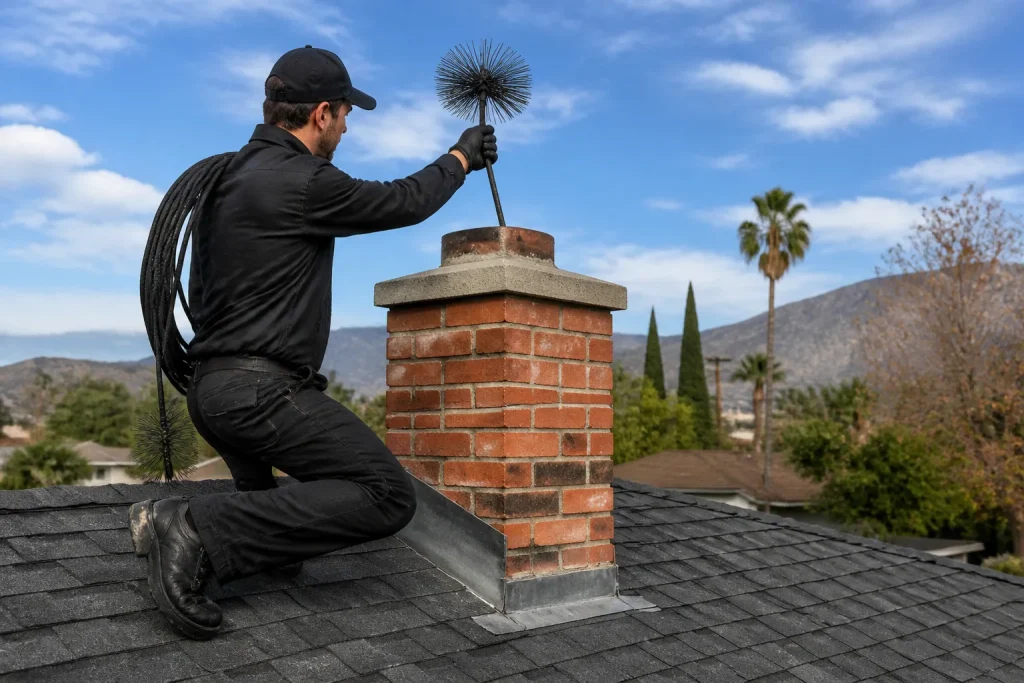
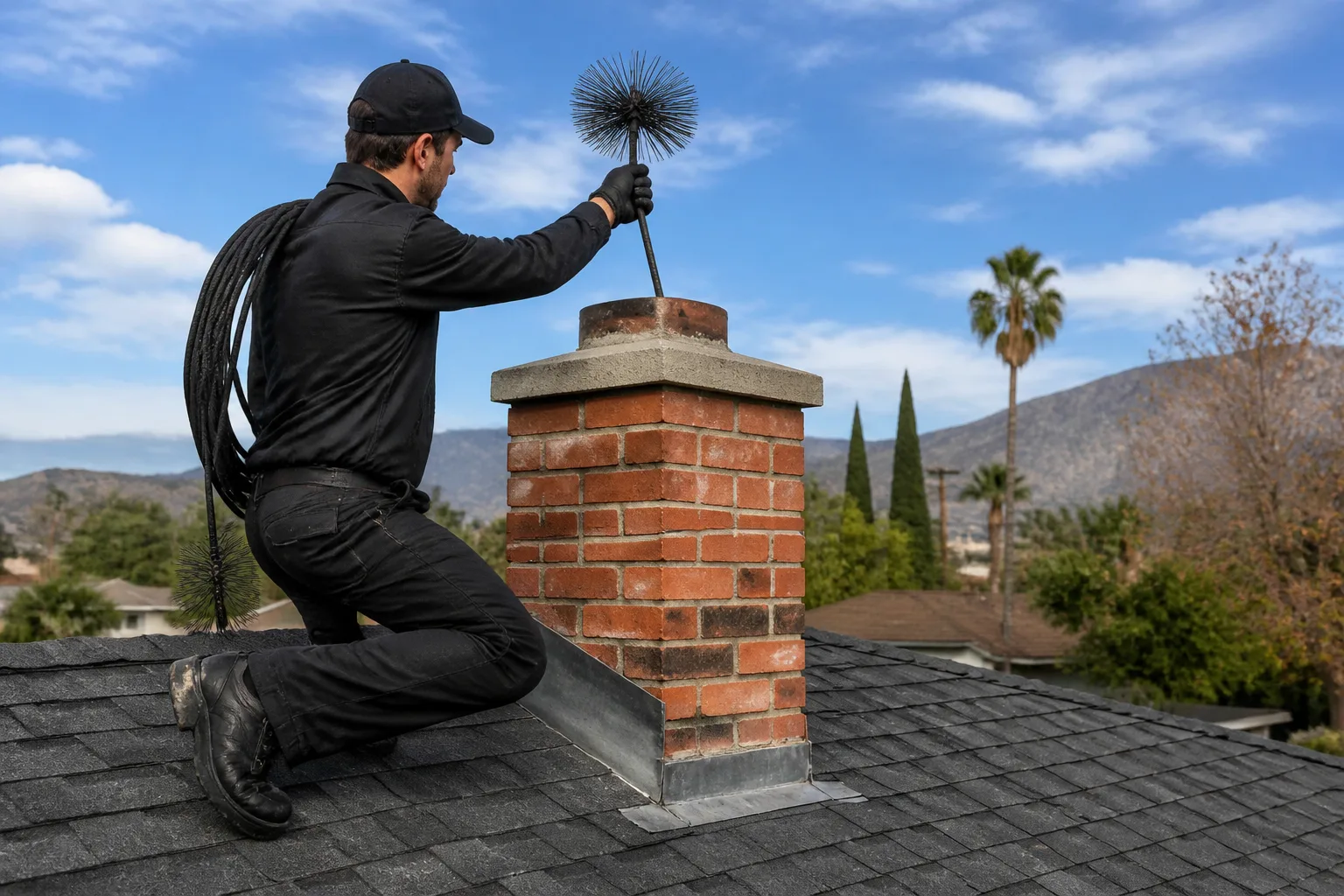
Sweeping a Gelco insert isn’t the same as sweeping an open masonry fireplace. The insert has to be removed or accessed through its designed service points so the liner can be brushed from the top and the firebox cleaned from inside. The blower fan and wiring should be inspected while the surround is open, because it’s the easiest time to do it.
A proper Gelco sweep includes:
- Removing the inner baffle or firebrick panels to reach the liner base.
- Brushing the full liner length from the top down, with the insert sealed to contain the dust.
- Vacuuming creosote from the smoke shelf and firebox floor.
- Checking the gasket seal and door latch tension.
- Verifying the blower spins freely and the snap disc still opens the circuit when the box heats up.
In Arleta’s mild winter climate, creosote doesn’t build up the way it does in cold, damp regions. But low, slow fires in an airtight insert still produce it, and Gelco units from the 80s tend to have tight, efficient fireboxes that burn cool enough to accumulate glaze creosote in the liner. An annual sweep is the right interval for most households that actually use their fireplace through the winter months.
When to Call a Pro
If you’ve found the model plate, photographed it, and you’re still not certain what liner diameter or gasket spec you need, stop there and call. The self-diagnosis question isn’t whether you can identify the problem. It’s whether you can correctly source the fix without burning the house down. Gas and liner work on a Gelco system involves clearances, connector tolerances, and code requirements that don’t forgive a wrong guess.
And there’s the other end of the house to consider. Your dryer vent is part of the same combustion-venting picture. A clogged dryer vent is one of the leading residential fire risks in Arleta, and it’s one most chimney-only companies never look at. Our dryer vent cleaning service is a standalone part of what we do, not an upsell. One call covers both the fireplace and the dryer line.
For chimney work, call (833) 958-9616. We answer 24/7. Fast dispatch from 7am to 7pm, Sunday through Friday.
Arleta Code and Clearance Considerations for Gelco Inserts
If you’re replacing a Gelco insert in Arleta, Los Angeles County code requires that the new appliance meet the same clearance-to-combustibles framework the original was listed under. That’s not optional. The original Gelco unit was tested and listed with specific clearances to the surrounding framing, and any replacement has to meet or exceed those numbers.
The practical issues in Arleta homes come down to three things:
- The chase dimensions in 1970s tract construction were often bare minimum, leaving little room for error on liner routing.
- The original clearances may not match the looser prescriptive rules newer prefab units assume.
- Permit requirements for insert replacement depend on whether you’re swapping an insert only, or changing the liner and venting configuration as well.
Most cities require a permit for a liner replacement that changes the venting path or diameter. If the replacement matches the original specs, the permit picture is simpler, but you should still check with your local building department rather than assume. The wrong clearance on an insert repair is a hidden problem, and it’s the kind of thing a home inspector flags when you try to sell.
Related services in Arleta: we offer Chimney Sweep Arleta services including sweeping, liner installation, and insert repair across the neighborhood.
The Bottom Line
A Gelco fireplace in Arleta is a well-built system that will keep running if it gets the right parts. The wrong liner, the wrong gasket, or a forced universal kit creates problems that compound, and those problems don’t announce themselves until the draft fails or the glass won’t stay clean. If you know you have a Gelco insert, service it by the model plate, not by guesswork.
If you’re in Arleta and need help with a Gelco sweep or repair, call Chimney Sweep Arleta at (833) 958-9616 for a free estimate. We’ll identify your system, explain what it actually needs, and show you the brands we’re installing before the work begins.
Frequently Asked Questions
Look for a metal plate inside the firebox opening, usually on the left or right interior wall. It will list the model number and venting diameter. Photograph it with your phone and reference that photo when discussing parts or service.
Gelco fireboxes have narrower openings than most generic prefab inserts, and standard kits are sized for the broadest masonry application. Forcing one to fit kinks the liner, compromises the joints, and voids the listing. A correctly sized liner, like DuraFlex in the proper diameter, fits without distortion.
Once a year if you use the fireplace regularly through the winter. Even in mild Arleta weather, low, slow fires in an airtight insert produce glaze creosote that builds in the liner. An annual sweep catches it before it becomes a removal problem.
A flattened gasket lets air enter the firebox at the wrong point, which disrupts the draft and causes glass blackening and cold air leaks when the fireplace is off. Replacing it with the correct diameter and density seal restores the door’s compression and the firebox’s performance. Call (833) 958-9616 if you suspect yours is gone.
Written by the team at Chimney Sweep Arleta, serving Arleta since 2017.
Need Chimney Cleaning Help?
Call Chimney Sweep Arleta - licensed & insured, with free written estimates in Arleta.
(833) 958-9616